
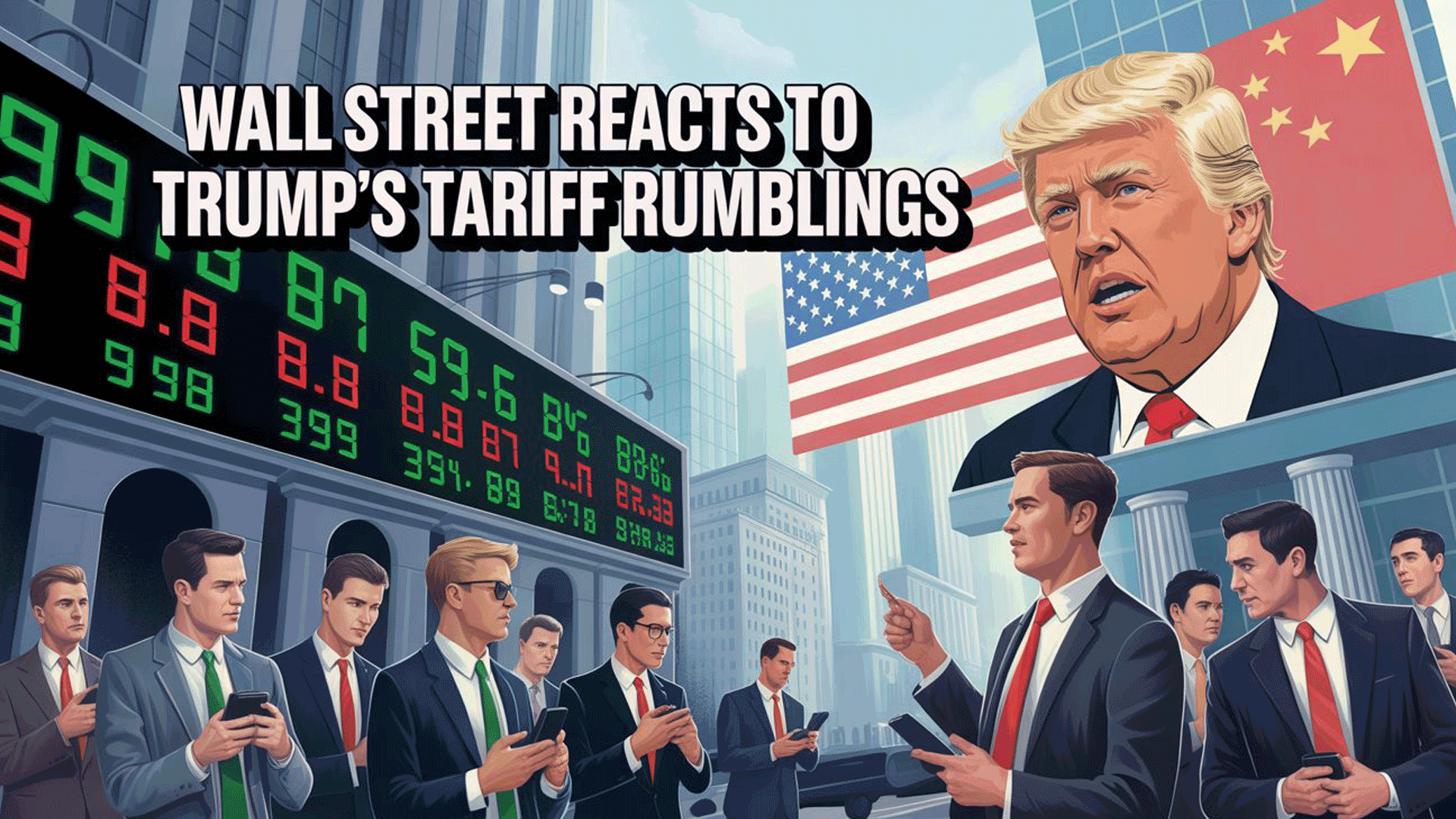
In what began as a jittery trading day, Wall Street shook off early volatility sparked by former U.S. President Donald Trump’s rumored tariff push on European Union goods. Despite the tension, the markets ended mostly unchanged, signaling investor resilience in the face of political headlines.
Let’s break down what happened, why it mattered, and what investors can take away from this week’s activity.
What Sparked the Dip in Markets?
Late Friday, a report from the Financial Times suggested that Donald Trump’s camp was advocating for steep new tariffs on European Union imports. According to the piece, the former President was pushing for a minimum tariff between 15% to 20% as part of any trade deal with the EU.
This news caused an immediate reaction across markets. Stocks dipped temporarily as investors braced for possible economic ripple effects. But as the day progressed, the major indexes regained their footing, suggesting that traders weren’t as quick to panic as in years past.
How Did Major Indexes Perform?
By the closing bell:
- The S&P 500 barely moved, shedding just 0.01% or 0.57 points, ending at 6,296.79.
- The Nasdaq Composite edged up by 0.05%, gaining 10.01 points to reach 20,895.66.
- The Dow Jones Industrial Average dipped 0.32%, falling 142.30 points to settle at 44,342.19.
Despite the brief sell-off, the broader market showcased resilience, bolstered by strong earnings reports and relatively solid economic data.
Investors Grow Immune to Trade Drama
Tariff talks used to send shockwaves through the markets, but this time, investors showed a level of calm rarely seen during trade war chatter. One possible reason? Many believe Trump’s trade threats may be more political posturing than actionable policy at this stage.
According to Greg Boutle, Head of U.S. Equity and Derivative Strategy at BNP Paribas:
“People are a little tired of trying to trade tariff headlines or deadlines. They’re now more focused on real numbers and actual economic impact.”
Economic Data Offers Mixed Signals
The week wasn’t just about Trump. Several key data releases painted a somewhat mixed picture of the U.S. economy:
- Retail Sales surged, reflecting strong consumer spending.
- Consumer Inflation rose, suggesting price pressures persist.
- Producer Prices, however, remained flat for June, offering a bit of relief for inflation hawks.
Additionally, the University of Michigan’s Consumer Sentiment Index ticked higher this month, though future inflation concerns remained in the background for many Americans.
Earnings Season Kicks Off with Surprises
Another major factor shaping the market’s tone was the start of Q2 earnings season. As of Friday, 59 S&P 500 companies had reported their results, with over 81% beating Wall Street expectations, according to LSEG I/B/E/S.
Some highlights included:
- Charles Schwab (SCHW) rose 2.9% after reporting solid profits.
- Regions Financial (RF) jumped 6.1% after increasing its 2025 interest income forecast.
- American Express (AXP) beat estimates but still dropped 2.3% – a sign that simply beating forecasts isn’t always enough.
- Netflix (NFLX) slid 5.1% even after a successful quarter boosted by shows like Squid Game, and an upgraded annual revenue outlook.
Interestingly, the market’s reaction to earnings results was not always predictable. Even companies delivering great numbers didn’t necessarily enjoy a bump in share price, underlining investor caution and high expectations.
3M, Energy Stocks See Pressure
Not all sectors shared the Nasdaq’s mild optimism:
- 3M (MMM) slipped 3.7%, citing that the bulk of tariff impacts will hit in the latter half of the year.
- The energy sector was the biggest loser, falling 1%. This was largely due to SLB dropping 3.9% after underwhelming earnings and ExxonMobil (XOM) losing 3.5% following a legal loss tied to Chevron’s acquisition of Hess.
Crypto Stocks Enjoy a Boost
In a surprising twist, crypto-related stocks like Robinhood (HOOD) and Coinbase (COIN) enjoyed solid gains of 4.1% and 2.2% respectively. This came after the U.S. House of Representatives passed a bill aimed at creating a clearer regulatory framework for digital assets.
For crypto investors, this is a sign that Washington may finally be moving toward structured oversight, which could boost mainstream confidence in digital currencies.
Sectors to Watch: Utilities Shine Bright
While energy stocks slumped, utilities came out as the top-performing sector. The utilities index (.SPLRCU) rose 1.7%, hitting a record close. Often seen as a defensive play during uncertain times, utility stocks gained favor among investors seeking stability amid political noise.
Takeaways: What Does This Mean for Investors?
The week’s movement reveals a few key insights:
- Tariff fears aren’t as scary anymore. Investors are growing desensitized to political drama unless it comes with concrete policy.
- Earnings still matter – but expectations are high. Beating estimates isn’t enough; forward guidance and outlooks are just as important.
- Markets crave clarity. Whether it’s inflation, trade, or crypto regulation – traders are favoring transparency and fundamentals over fear.
Tips for Navigating Political Market Volatility
- Avoid Knee-Jerk Reactions: Let the news settle before making trading decisions.
- Diversify Your Portfolio: Spread out risk across sectors and asset classes.
- Keep an Eye on Data: Economic indicators provide better long-term insight than headlines.
- Watch the Fed, Not Just Politicians: Central bank policy often outweighs political statements in market impact.
Conclusion: A Resilient Market Amid the Noise
While Trump’s tariff chatter may have triggered a short-lived wobble on Wall Street, the broader takeaway is clear: investors aren’t as easily rattled as they once were. Strong earnings, stable consumer sentiment, and moderate inflation helped balance the scales, leading to a relatively flat finish for the week.
The markets remain on edge for any meaningful policy shift, but for now, the fundamentals are holding strong.
FAQs: Market Reactions to Trump Tariff Rumors
Q1: Why did markets dip briefly on Friday?
A Financial Times report hinted that Trump was pushing for new tariffs on EU goods, causing short-term uncertainty.
Q2: Did major indexes crash?
No. The S&P 500 and Nasdaq ended flat, and the Dow saw only a modest decline.
Q3: Are tariffs still a big concern for investors?
While still relevant, markets seem less reactive to tariff talk than in previous years.
Q4: What sectors were most affected?
Energy and industrials took a hit, while utilities and crypto stocks performed well.
Q5: How did earnings influence the market?
Companies beating estimates didn’t always see stock gains, showing that investors expect strong forward guidance as well.
